Key takeawaysOpen this summary to review the essential ideas.
- Practical answer
- Compare the yarn length you have with the length still needed. To estimate leftovers, use the metres-per-gram ratio on the label and weigh only the yarn. Step by Step Crochet helps organise your inventory; the decision still depends on your records, the pattern and a comparable swatch.
- Can I judge the amount by looking at the ball?
- Appearance can mislead. Weight and the label give a more comparable estimate than the visible size of a remnant.
- Does the inventory guarantee enough yarn?
- No. It organises quantities; compare them with the project’s consumption and any yarn reserved for other work.
Practical answer
Compare the yarn length you have with the length still needed. To estimate leftovers, use the metres-per-gram ratio on the label and weigh only the yarn. Step by Step Crochet helps organise your inventory; the decision still depends on your records, the pattern and a comparable swatch.
Convert leftovers into a comparable unit
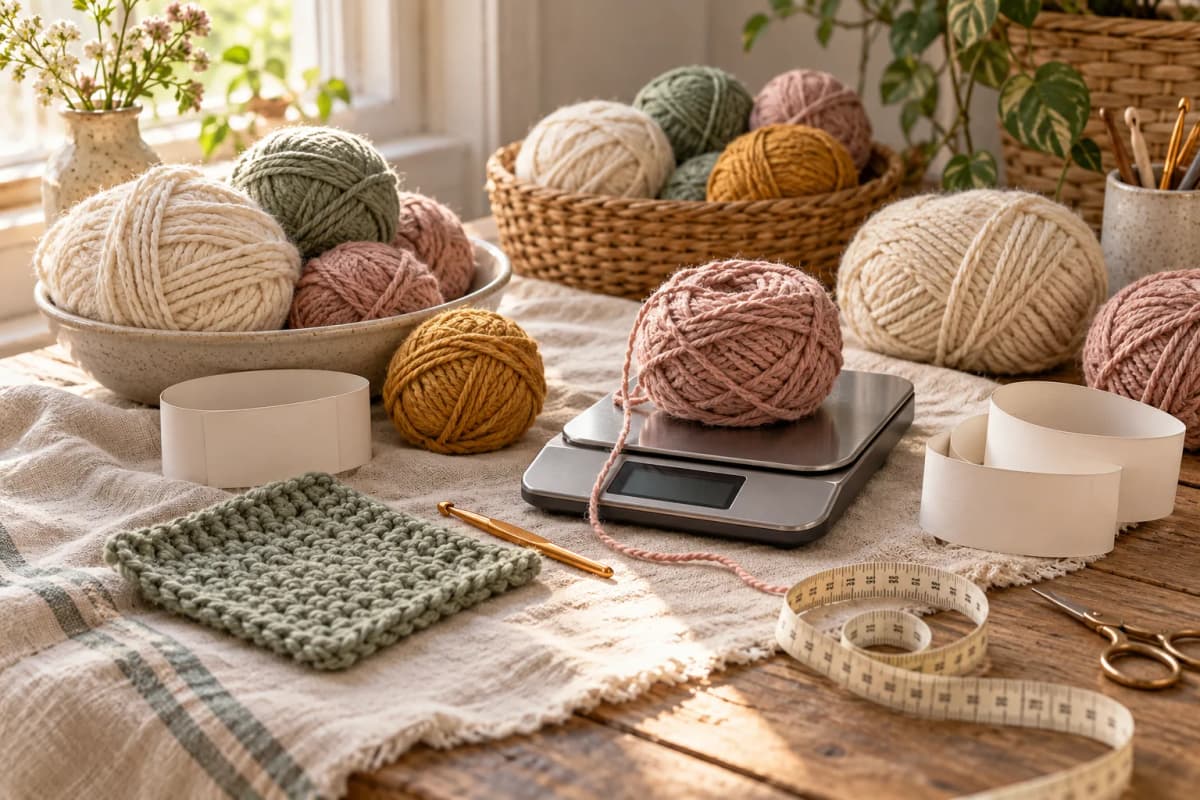
A label stating 200 metres per 100 grams gives a ratio of 2 metres per gram. A 35-gram remnant of that same yarn represents approximately 70 metres. Exclude cones, bags and other supports from the weight. This conversion estimates length from the label: do not apply another yarn’s ratio simply because its thickness looks similar.
Estimate the unfinished work
Start with the pattern’s consumption for your size when available. If you have completed a repetitive section, weighing a comparable piece can help estimate the next one. A swatch should use the same stitch, hook and tension. Edgings, handles and changes of stitch consume additional yarn, so scaling flat area alone does not always describe everything you still need to make.
Check each colour and each reservation
Separate yarn for this project from yarn already allocated to another. Having 100 grams in a box does not make all of it available. Check brand, yarn reference, colour and dye lot; similar-looking balls may behave differently. Our recommended workflow combines Step by Step Crochet’s inventory with the physical labels and a note explaining your calculation.
Put it into practice
- Identify the exact yarn and its length-to-weight ratio.
- Weigh the remnant without packaging or supports.
- Multiply grams by metres per gram.
- Estimate the remaining work from the pattern or a comparable swatch.
- Choose a reasoned allowance for finishing and differences in tension.
Worked example
Hypothetical calculation: 35 g of a yarn labelled 200 m/100 g gives 70 m available. If the remaining work needs an estimated 90 m and you choose a 10% allowance for this example, you need 99 m. The shortfall is about 29 m. That 10% is an illustrative choice, not a universal recommendation.
The numbers at a glance
| Item | Example calculation | Result |
|---|---|---|
| Label ratio | 200 m ÷ 100 g | 2 m/g |
| Available yarn | 35 g × 2 m/g | 70 m |
| Need with chosen allowance | 90 m × 1.10 | 99 m |
| Shortfall | 99 m − 70 m | 29 m |
Frequently asked questions
Can I judge the amount by looking at the ball?
Appearance can mislead. Weight and the label give a more comparable estimate than the visible size of a remnant.
Does the inventory guarantee enough yarn?
No. It organises quantities; compare them with the project’s consumption and any yarn reserved for other work.
Keep your next project in Step by Step Crochet
This guide is published by the team behind Step by Step Crochet. Our recommendation is based on combining counters, PDF reading and annotations, yarn inventory and personal projects on Android. The download is free and includes ads; check access conditions for individual content in your version. The iPhone version may offer different features. Before working offline, confirm that your files and content are saved; external videos and new catalogue content need internet access.
Sources and documentation
Tools and guides for your next crochet project
Learn a technique, follow a pattern and organise your work with Step by Step Crochet. Explore how each Android feature helps.
Keep your next project on your phone
Download Step by Step Crochet from Google Play. The app from Molly Digital is free to download and contains ads. Check the official listing for the available version.
Get it on Google Play